Pete Marin, a seasoned airbrush professional at Airbrush Events, unveils valuable insights on crafting airbrush pricing strategies for both event-based and retail settings. This article, inspired by his informative video, serves as a guide for aspiring airbrush artists navigating the world of pricing with confidence.
Understanding the Pricing Landscape:
First, Pete draws a clear line between contract-based event services and individual item sales in retail environments. He uses his own company’s event work as an example, highlighting the distinct airbrush pricing strategies involved compared to an airbrush store selling individual t-shirts or hats.

Event Airbrushing: Building Your Cost Foundation
Pete emphasizes the importance of understanding your costs before setting prices. He suggests:
- Calculating per-hour costs: Estimate how many items you can paint per hour (e.g., t-shirts) and factor in material costs (t-shirts, paint, etc.).
- Accounting for additional expenses: Include travel, equipment, and other event-specific costs.
- Developing a baseline: This incorporates all calculated costs per hour, forming the bedrock of your event airbrush pricing strategies.
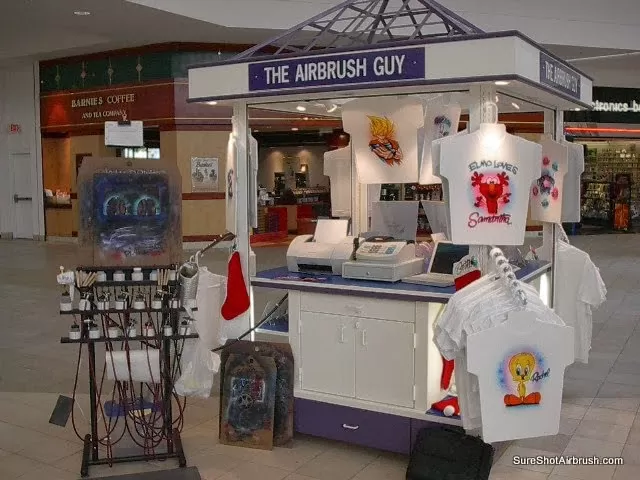
Retail Airbrushing: Value Perception is Key
For retail, Pete focuses on the power of perceived value:
- Understanding customer expectations: Consider what customers are willing to pay for airbrushed items (e.g., t-shirts).
- Creating standard designs: Offer quick-to-paint options within an appealing price range (e.g., 20–30 minutes, 20-30 dollars). These “fast and clean” designs become your bread and butter, allowing you to hone your skills and cater to customer expectations while maintaining profitability.
- Leveraging your skills: Focus on clean, efficient designs that showcase your expertise, even within more affordable price points.
Profit Margin and Growth: A Strategic Balancing Act
Pete advises determining a comfortable profit margin and considering:
- Building experience: Initially, lower prices can attract more clients and gain valuable experience, laying the groundwork for future pricing adjustments.
- Raising rates later: As your skills and business grow, you can gradually increase prices, reflecting your enhanced expertise and demand.
Growth Strategies: Scaling Your Airbrush Business
As your business expands, Pete suggests:
- Improving systems: Streamline your workflow for efficiency, allowing you to take on more work while maintaining quality.
- Utilizing technology: A website, CRM, or upgraded equipment can ease your workload and elevate your professional image.
- Hiring help: When workload demands, consider hiring assistants, allowing you to delegate tasks and focus on strategic growth.
Conclusion: Experience Paves the Way
Pete encourages new airbrush artists to prioritize skill development and experience initially. By understanding costs, perceived value, and implementing effective airbrush pricing strategies, you can confidently navigate the pricing landscape in both event and retail settings.
Please note: This article does not disclose specific pricing information, as that was not the intention of the original video. However, it provides valuable insights and a framework to approach pricing based on your individual business model and goals.
Ready to dive deeper? Watch Pete’s full video for even more detailed advice and insights on crafting successful airbrush pricing strategies:
Common Questions: Airbrush Pricing & Business
What is the difference between event-based and retail airbrush pricing?
Event pricing is usually a contracted flat rate where the client pays for your time and the total number of items provided. Retail pricing is per item, focused on the specific design requested by an individual customer. At AE Academy, we teach that understanding this distinction is the first step to a profitable business.
What is the “Clean Cheese” strategy in airbrushing?
This is a core concept taught by Pete Marin. It involves creating high-quality, “clean” designs that can be finished quickly (usually under 30 minutes). These become your “bread and butter” items that keep the line moving and the revenue flowing without burning out the artist.
How should a new airbrush artist calculate their baseline event cost?
Start by calculating your per-hour cost, which includes your labor and the wholesale cost of the items you expect to paint (like t-shirts or hats). Don’t forget to add hidden expenses like travel, set-up time, and equipment wear-and-tear.
Should new airbrush artists start with lower prices?
In the beginning, experience is more valuable than high profit. Starting with slightly lower, competitive rates helps you gain “seat time” and build a portfolio. Once you can paint faster and produce higher-quality work consistently, your market demand will allow you to raise your rates.
How can I increase my airbrush business profits without raising prices?
Profitability often comes from efficiency. By improving your painting systems, organizing your workspace for faster color changes, and using better technology (like professional stencils or high-flow compressors), you can finish more items per hour, which raises your effective pay rate.
