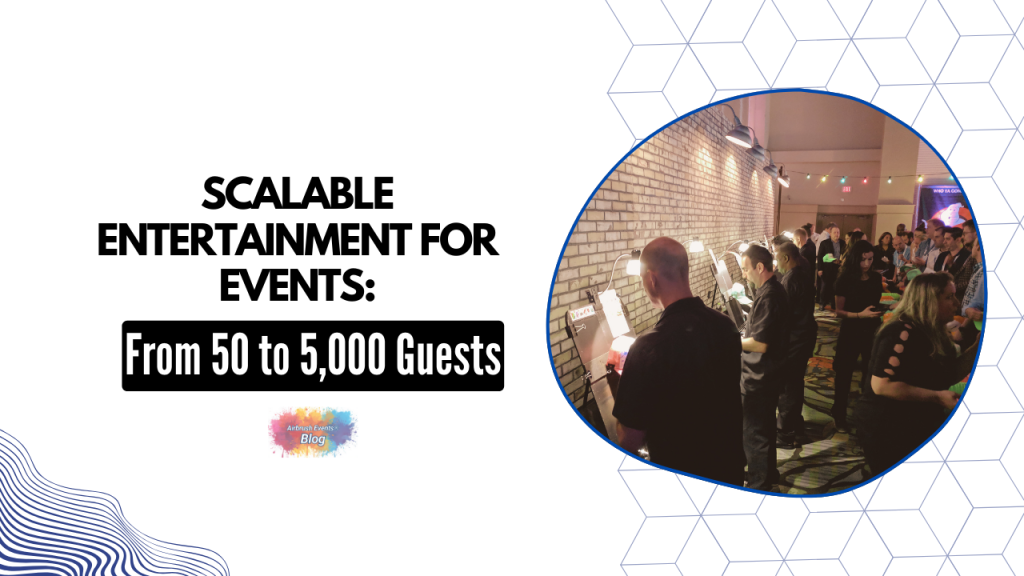
Planning entertainment for corporate events shouldn’t feel like solving a complex math problem. Whether you’re organizing an intimate gathering of 50 people or a massive brand activation for thousands, you need entertainment that scales seamlessly without compromising quality or breaking your timeline.
If you’ve ever wondered “how many entertainers do I actually need?” or “will this work for my event size?” – this guide breaks down exactly how scalable entertainment works and what you should expect from professional vendors.
Understanding Scalable Event Entertainment
Scalable entertainment adapts to your specific event size, duration, and guest flow. The best vendors don’t just show up with more people for bigger events. They have a systematic approach to matching resources with your needs.
At Airbrush Events®, we’ve worked everything from intimate birthday parties to events with 5,000 attendees. While Airbrush Events has been in business for seven years, our processes and systems have been refined over 15 years of live event experience. Here’s what that depth of experience has taught us about matching entertainment to event size.
The Math Behind Scalable Entertainment
Production Capacity: What One Artist Can Handle
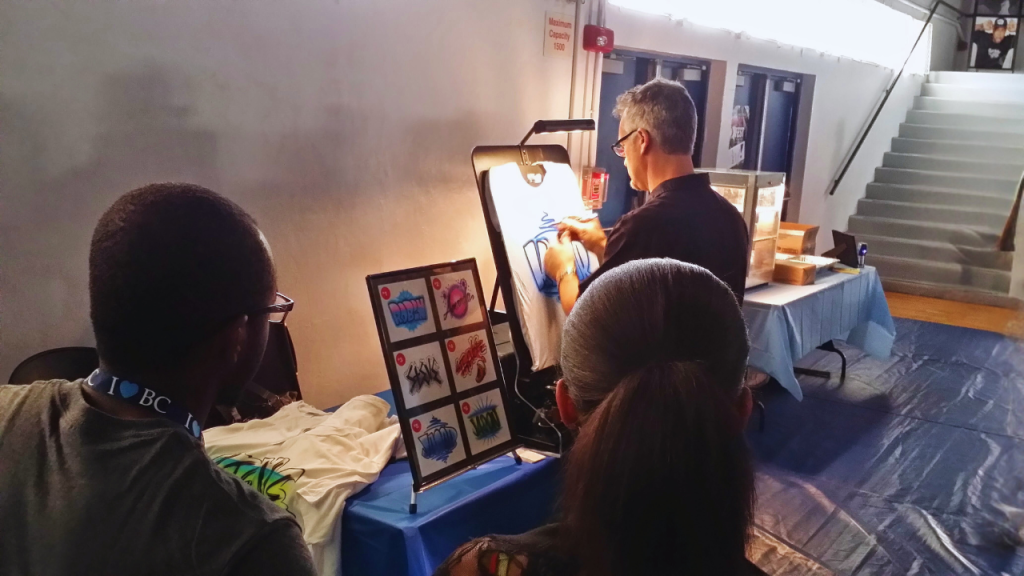
Understanding throughput helps you plan realistically. For custom airbrush entertainment:
T-Shirt Customization: Approximately 25 customized shirts per hour per artist Hat Customization: Approximately 35 customized hats per hour per artist
While t-shirts and hats are our most common items (representing about 95% of events), we customize much more than that. Our artists can airbrush hoodies, sweatshirts, bucket hats, beanies, socks, sports balls, and various other items. The production rate varies slightly depending on the item, but these numbers give you a solid baseline for planning.
Each item includes taking the guest’s design choice, airbrushing their name or selected design, and handing them their finished piece.
Calculating Your Artist Requirements
Here’s the formula event planners can use:
(Number of Guests ÷ Event Duration in Hours) ÷ 25 = Artists Needed
Real-World Example 1:
- Event: 200-person corporate party
- Duration: 3 hours
- Calculation: 200 ÷ 3 = 67 items per hour needed
- 67 ÷ 25 = 2.68, so 3 artists recommended
Real-World Example 2:
- Event: 500-person brand activation
- Duration: 2 hours
- Calculation: 500 ÷ 2 = 250 items per hour needed
- 250 ÷ 25 = 10 artists needed
Real-World Example 3:
- Event: 50-person wedding reception
- Duration: 4 hours
- Calculation: 50 ÷ 4 = 12.5 items per hour needed
- 12.5 ÷ 25 = 1 artist is plenty

Planning for 100% Participation (Yes, Really)
One mistake event planners make is underestimating participation rates. You might think, “Not everyone will want a custom shirt, right?”
Wrong. Once guests see other people walking around with their personalized items, FOMO kicks in hard.
Our recommendation: Plan for 100% participation at contained events like corporate parties, bar mitzvahs, weddings, and private celebrations where you have a known guest count.
Different Event Types, Different Calculations
Contained Events (Corporate, Private Parties, Weddings)
Guest Count: Known and controlled Recommendation: Plan for 100% participation
These events have clear start and end times with a specific guest list. You can calculate exactly how many artists you need based on total attendance.
Open-Traffic Events (Trade Shows, Brand Activations, Festivals)
Guest Count: Unknown and variable Recommendation: Calculate based on hours of coverage desired
For a trade show booth with one artist working 3 hours, you’ll produce approximately 75 custom shirts. That’s your giveaway capacity. If you want to give away 150 items, book the artist for 6 hours or bring two artists for 3 hours each.
Merchandise: Who Provides What?
Event planners often ask whether they need to supply the items we’ll customize. Here’s how it typically works:
Option 1: We Provide Everything (Most Common) The majority of our clients have us provide the blank merchandise. We bring exactly what’s needed based on your guest count, plus a small buffer for sizing mix-ups.
Option 2: Client-Provided Merchandise Some clients want specific shirt brands, hoodies instead of t-shirts, or other particular items. That’s completely fine. We’ll customize whatever you provide.
Option 3: Pre-Printed with Logos We have an in-house printing operation. If you want company logos, event themes, or custom branding already printed on the items before we arrive, we handle that too. Then our artists focus solely on adding personalized names and designs at the event itself.
Coordinating Multiple Artists
When your event requires multiple artists, you might wonder how coordination works. Do they all show up separately? Will there be chaos?
Our Team Coordination Process
Before the Event:
- Artists receive identical event information through our internal app
- For multi-artist events, we create dedicated group chats
- Everyone knows arrival time, setup location, and their role
- Travel and logistics are handled by our operations team
During the Event:
- Artists work as a coordinated team, not individuals
- One person typically serves as lead contact with your team
- Professional crowd management across all stations
With 25+ Artists Nationwide: We can staff events of virtually any size. Whether you need 2 artists or 15, we have experienced professionals ready to travel to your location.
How Scalability Works in Practice
The difference between a vendor who can scale and one who just claims they can comes down to systems and experience.
Small Events (Under 100 Guests)
Typical Artist Count: 1-2 artists Event Duration: Usually 2-4 hours What Makes It Work: Single artist can manage the entire guest experience, from greeting to delivery
Small events are straightforward. One artist arrives, sets up their station, and creates a personal experience for each guest. There’s no complexity in coordination because there’s no team to coordinate.
Medium Events (100-300 Guests)
Typical Artist Count: 2-5 artists Event Duration: Usually 2-4 hours
What Makes It Work: Multiple stations reduce wait times, artists can cover more ground
At this scale, you start to see the benefits of true scalability. Multiple artists mean shorter lines and better guest flow. But it also requires coordination. Artists need to maintain consistent quality and similar production speeds so one station doesn’t become a bottleneck.
Large Events (300-1,000 Guests)
Typical Artist Count: 5-10+ artists Event Duration: Varies based on event type What Makes It Work: Systematic coordination, designated team lead, synchronized setup and breakdown
Large events require real operational systems. This is where amateur vendors fall apart and professional operations shine. You need artists who can work independently while maintaining team standards. Communication systems matter. Setup logistics become more complex.
Massive Events (1,000+ Guests)
Typical Artist Count: 10-25 artists (our maximum capacity) Event Duration: Often multi-day or extended hours What Makes It Work: Advanced planning, staging areas, supply management, experienced leadership
At this scale, you’re essentially running a small production operation. We’ve done events with 5,000 attendees where we deployed our full team across multiple activation points. These events require weeks of advance planning, detailed logistics coordination, and experienced artists who’ve worked large crowds before.
Real-World Flexibility: What Happens When Plans Change?
Events rarely go exactly as planned. Professional entertainment vendors should handle changes smoothly.
Common Scenarios We Handle
Guest Count Changes: Booked for 200, but 250 showed up? As long as merchandise is available, we keep painting. The math might get tight, but scalable entertainment means we adapt.
Timeline Shifts: Dinner ran late and the event starts 30 minutes behind schedule? We adjust our production expectations and keep the guest experience smooth.
Venue Issues: Setup location changed at the last minute? Experienced artists roll with venue challenges because they’ve seen it all before.
Booking Considerations for Different Event Sizes
Small Events (50-100 Guests)
Artists Needed: Typically 1-2 Recommended Duration: 2-4 hours
Best For: Intimate celebrations, small corporate gatherings, private parties Booking Timeline: 2-4 weeks in advance typically sufficient
Medium Events (100-300 Guests)
Artists Needed: Typically 2-5 Recommended Duration: 2-4 hours Best For: Corporate events, larger weddings, bar/bat mitzvahs, school events Booking Timeline: 4-8 weeks advance booking recommended
Large Events (300-1,000 Guests)
Artists Needed: Typically 5-10+ Recommended Duration: 2-4 hours Best For: Large corporate functions, festivals, major brand activations Booking Timeline: 8-12 weeks advance booking recommended Additional Considerations: May require venue walkthroughs, detailed logistics planning
Massive Events (1,000+ Guests)
Artists Needed: 10-25 (we have 25+ nationwide) Recommended Duration: Varies by event type Best For: Major festivals, large brand activations, convention entertainment Booking Timeline: 12+ weeks advance booking essential Additional Considerations: Requires detailed planning, possible staged setup, coordination with other vendors
Questions Event Planners Should Ask Any Scalable Entertainment Vendor
When vetting entertainment vendors, event planning experts recommend evaluating portfolios, communication style, and contract details before booking. For scalable entertainment specifically, here are the critical questions to ask:
- What’s your actual production capacity per hour? (Get specific numbers, not vague promises)
- How many professionals do you have available? (Ensures they can actually staff your event size)
- What happens if more guests show up than expected? (Tests their flexibility)
- Who coordinates multiple entertainers at large events? (Reveals their organizational capability)
- How do you handle communication between artists at multi-artist events? (Shows their systems)
- Can you provide references from similar-sized events? (Verifies experience at your scale)
- What’s your advance booking requirement for events of my size? (Helps you plan your timeline)
- Have you worked events with [your guest count] before? (Direct experience matters)
- How do you ensure quality consistency across multiple artists? (Critical for guest experience)
- What’s your maximum capacity? (Know their limits before you book)
Why Scalability Matters More Than You Think
Most vendors hit a ceiling. They can handle 100 guests beautifully, but at 300 guests, quality falls apart or timelines explode. Scalable entertainment maintains consistent quality regardless of size.
Systems beat improvisation. Amateur vendors improvise solutions for each event size. Professional scalable vendors have tested systems that work at 50 guests and 5,000 guests.
Team depth matters. True scalability requires a team, not just a talented individual who tries to recruit friends for bigger gigs. Professional teams train together and maintain standards.
The Bottom Line on Scalable Entertainment
Event entertainment should scale as seamlessly as your catering or your AV setup. The math isn’t complicated once you understand production capacity, but the execution requires professional systems and experienced teams.
Whether you’re planning for 50 guests or 5,000, the principles remain the same:
- Calculate realistically based on production capacity
- Plan for higher participation than you expect
- Work with vendors who have systematic approaches to scaling
- Verify they have the team depth to staff your event
- Book early enough to secure adequate staffing
The right entertainment partner doesn’t just show up and perform. They help you plan accurately, scale appropriately, and deliver an experience that guests remember long after your event ends.
Ready to Plan Your Event Entertainment?
Understanding how entertainment scales is the first step. The next step is working with a team that’s done it hundreds of times before at events of every size.
At Airbrush Events, we’ve spent seven years perfecting scalable entertainment systems, built on 15 years of live event experience. From intimate gatherings to massive activations, our 25+ artists nationwide bring the same level of professionalism and quality to every event.Want to calculate exactly what your event needs? Let’s talk specifics about your guest count, timeline, and vision.