
Most planners ask about price. The smart ones ask for paperwork. Here’s exactly what separates a professional vendor from a liability waiting to happen.
Your vendor looked great on Instagram.
Slick photos. Impressive reel. Glowing testimonials.
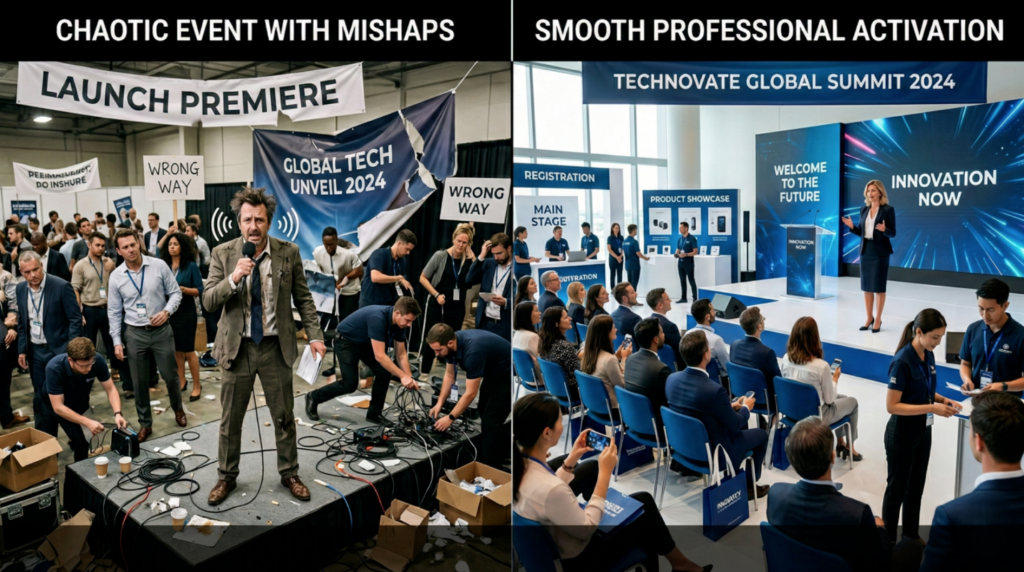
And then they showed up 45 minutes late, had no backup plan for the broken equipment, and handed their own business cards to your CEO.
Sound familiar?
Here’s the problem. Most planners vet vendors the wrong way. They look at portfolios and pricing. They check reviews. They hop on a quick call.
What they don’t do is ask for the paperwork.
The documents a vendor has, or doesn’t have, tell you everything. They show you whether this is a real operation or a freelancer winging it. They tell you what happens when things go sideways. They protect your budget, your event, and, honestly, your job.
Here are the 5 documents worth asking for before you sign a single contract.
1. Operational Continuity & Contingency Policy
Translation: What’s the plan when things go wrong?
Every vendor will tell you they’re reliable. Ask for the document that proves it.
An Operational Continuity Policy lays out exactly what happens when equipment breaks mid-event, when an artist misses a flight, when the venue loses power. Not in vague “we’ll figure it out” language. In writing.
This is the document that separates vendors who have been through things from vendors who are about to experience their first crisis at your event.
| What to look for: Does it cover equipment failure, travel disruptions, and weather? Does it outline specific backup protocols, not just “we’ll do our best”? Does it address who’s financially responsible when things fall apart? |
The real question it answers: Can this vendor handle a problem without making it your problem?
2. Certificate of Insurance (COI)
Translation: If something breaks or someone gets hurt, who’s paying?
This one isn’t optional. It’s table stakes.
A legitimate vendor carries general liability insurance and, if they have employees or contractors working your event, workers’ compensation coverage. They should be able to send you a Certificate of Insurance before the event, naming your organization as an additional insured.
If a vendor can’t produce a COI within 24 hours of being asked, that’s your answer right there.
| What to look for: General liability coverage (at least $1M per occurrence is standard for corporate events). Workers’ comp if they’re bringing a team. Willingness to list your company as additionally insured. |
The real question it answers: Are you protected if this goes badly?
3. ESG Commitment Statement
Translation: Does this vendor operate like a responsible business?
ESG (Environmental, Social, and Governance) used to be something only Fortune 500 companies worried about. Not anymore.
Corporate procurement teams are increasingly requiring ESG compliance from vendors. Your sustainability commitments extend to who you hire. If a vendor uses toxic materials, has no labor standards, or can’t speak to their environmental practices, that reflects on your brand too.
An ESG statement doesn’t have to be 40 pages long. It should cover the basics: what materials they use, how they treat their workers, and whether they’ve thought beyond the transaction.
| What to look for: Non-toxic materials (especially important for branded merchandise that guests take home). Clear labor standards for their team. Some acknowledgment of sustainability practices, even if modest. |
The real question it answers: Will hiring this vendor create any brand risk for you?
4. DEIA Policy
Translation: Is this a company your company would be proud to work with?
Diversity, Equity, Inclusion, and Accessibility. Four words that matter a lot to HR departments, employee resource groups, and anyone who’s ever had to justify vendor selections to a DEI committee.
A solid DEIA policy tells you two things. First, that this vendor has thought about who’s on their team and whether it reflects the guests they’re serving. Second, that their services are actually accessible, not just physically, but in how their team interacts with a diverse group of people.
This matters even more when the vendor is customer-facing at your event. They’re a direct extension of your brand for the duration of that activation.
| What to look for: Inclusive hiring practices, not just checkbox language. Accessible service design (can guests with mobility limitations participate?). Evidence that diversity is built into their operations, not bolted on. |
The real question it answers: Will this vendor represent your company’s values when they’re standing in your name?

5. Training & Certification Documentation
Translation: Are these people actually qualified?
Anyone can call themselves a professional. The ones who actually are have paperwork.
This looks different depending on the vendor category. A catering company might have ServSafe certifications. An AV team might have manufacturer certifications on its equipment. A live entertainment vendor might have a proprietary training and certification program for their performers.
The point isn’t to collect certificates for the sake of it. The point is to understand whether this vendor has invested in making their team consistently good, or whether each event is a roll of the dice on whoever showed up that day.
| What to look for: Evidence of standardized training, not just “experienced artists” or “seasoned professionals.” Ideally, a formal program with defined criteria. Bonus points for any third-party or industry association certifications. |
The real question it answers: Do you get the same quality every single time, or just when you’re lucky?
The Bottom Line
Great vendors are easy to find.
Vendors who can prove they’re great? That’s a much shorter list.
The five documents above aren’t bureaucratic hoops. They’re the difference between a vendor who shows up and performs and one who shows up, breaks something, and leaves you explaining it to your leadership team.
The best vendors won’t be annoyed when you ask for these. They’ll already have them ready.
And the ones who push back, get vague, or tell you they “don’t really do that”?
You just learned something important about them before it cost you anything.
For the record, we keep all five of these on file. Ready to send before you ask.
Quick Reference: The Vendor Vetting Checklist
| Document | What it proves |
|---|---|
| Operational Continuity Policy | They have a real plan B (and C) |
| Certificate of Insurance (COI) | You’re protected if something goes wrong |
| ESG Commitment Statement | Their business practices won’t embarrass yours |
| DEIA Policy | Their team reflects your company’s values |
| Training & Certification Docs | Quality is consistent, not accidental |