
You got 623 people to show up.
Your CEO still hates your event.
Here’s why.
The Attendance Trap
Attendance is a fake success metric.
It measures who showed up.
Not what they learned.
Not what they did afterward.
Not what changed.
Your CEO knows this.
They’ve been to enough meetings to know the difference between activity and results. Your event had high attendance the same way a traffic jam has high participation.
Everyone was there. But did anything actually move forward?
What Your CEO Is Really Asking
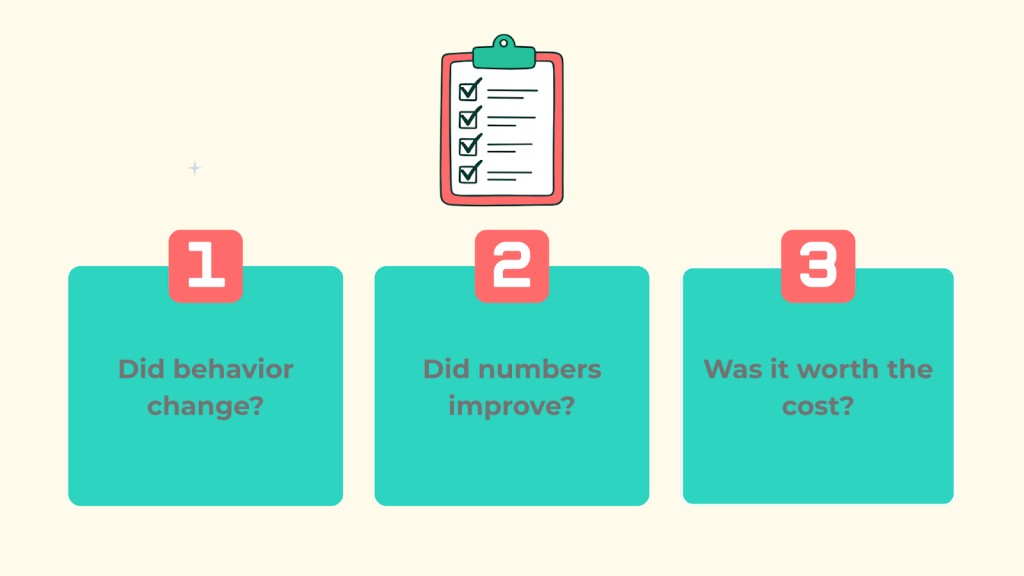
When your CEO asks about your event, they’re not asking how many people came.
They’re asking three questions:
1. Did this change what people do?
Did sales reps actually start using the new pitch? Did the leadership team finally agree on the strategy? Did employees do anything different at work?
Or did they just sit in chairs for six hours and go back to business as usual?
2. Did the numbers improve?
Sales. Retention. Performance. Speed.
Your CEO doesn’t care if 623 people attended your training event. They care if those 623 people got better at their jobs afterward.
3. Was this worth the money?
Here’s what your CEO is calculating:
- Event cost: $100,000+
- 623 people attended
- Average employee time (6 hours): $282 in lost work
- That’s real money per person on top of your event budget
If those 623 people didn’t change anything afterward, you just spent a lot of money on an expensive day off.
What CEOs Actually Care About

Forget attendance numbers.
Here’s what actually matters:
1. Did People Change What They Do?
Not “did they learn something.”
Did they actually do something different after your event?
Real example:
You ran a sales training event. Three months later, are your sales reps actually using the new pitch? Or did they go right back to their old habits?
How to track this:
- Check in 30 days later (not the day after)
- Ask their managers what changed
- Look at what they’re actually doing in real work
What this looks like:
“78 out of 90 sales reps are now using the new pitch framework in their calls. I know because their managers confirmed it and I listened to call recordings.”
That’s something your CEO can understand.
2. Did The Numbers Move?
Your event cost the company lots of money.
Did it make the business better?
Real example:
You spent six figures on a training event. Are those people now selling more? Staying at the company longer? Getting work done faster?
According to Gallup’s State of the Global Workplace report, companies with highly engaged teams see 21% greater profitability, proving the direct link between employee development and business outcomes.
How to track this:
- Pick one number that matters to your business
- Measure it before the event
- Measure it 90 days after
- Compare the difference
What this looks like:
“Sales reps who went to the event are closing deals 18% faster than they were before. Reps who didn’t go? Their speed stayed the same.”
Now you have proof your event worked.
3. Did Your Leaders Get On The Same Page?
This one’s harder to measure.
But you know it when you see it.
Real example:
Your leadership team keeps sending mixed messages. Product says one thing. Sales says another. Your team is confused and nothing moves forward.
After your offsite, are they finally aligned?
How to track this:
- Ask leaders before the event: “What are our top 3 priorities?”
- Count how many different answers you get
- Ask again 60 days after the event
- See if the answers match now
What this looks like:
“Before the offsite, our 8 executives had 12 different versions of our Q4 strategy. After the offsite? They all said the same 3 things. And their teams stopped getting conflicting directions.”
That’s worth money to a CEO.
4. Was It Worth The Cost?
This is the question every CEO is actually asking.
Here’s the math they’re doing in their head:
Your event cost loads.
You had 623 people attend.
But wait.
Each person was there for 6 hours. If their average salary is $95,000, that’s $47/hour. Times 6 hours = $282 in lost work time per person.
That’s $175,686 in lost productivity across your whole team.
Speaking of hidden costs, most planners don’t realize they’re also losing money on last-minute vendor changes that could be completely avoided.
Now the question: Was it worth it?
If those 623 people didn’t change anything after, you just paid for a very expensive day off.
But if those people now work faster, sell more, or stay at the company longer?
Your event just paid for itself many times over.
That’s the math your CEO wants to see.
Why This Matters In Budget Meetings
Here’s what happens when you ask for event budget:
Your pitch: “We had record attendance at our Q2 event. 623 people showed up, feedback scores were 8.7/10, and people loved it.”
What your CEO hears: “We spent a lot of money on something people enjoyed but I have no idea if it actually mattered.”
Better pitch: “Our Q2 event got 78 out of 90 sales reps using the new pitch framework. Those reps are now closing deals 18% faster. That means they’re fitting more deals into the same quarter, which directly impacts revenue.”
What your CEO hears: “This person understands how the business works.”
What We See Working
When we work with corporate clients, we see planners who understand this get their budgets approved.
The ones who don’t? They’re stuck explaining why they need money for “team building” and “engagement.”
Attendance without results is just expensive hospitality.
And your CEO knows it.
The 3 Things To Define Before Your Next Event
Before you plan anything, write down these three things:
1. What Specific Behavior Needs To Change?
Not “increase engagement.”
Specific actions. Specific timeline.
Examples:
- “Sales reps will use the new pitch in 80% of their calls within 30 days”
- “Managers will do monthly 1:1s with their team using the new format within 60 days”
- “Teams will make decisions in 7 days instead of 14 days within 90 days”
2. What Business Problem Are You Solving?
Not “team building.”
Real problems. Real numbers.
Examples:
- Sales per rep is down
- People keep quitting
- New hires take too long to get productive
- Deals are taking forever to close
- Leaders can’t agree on strategy
3. How Will You Know If It Worked?
Not “we’ll send a survey.”
Real tracking. Real timelines.
The plan:
- Week 1: Measure the starting point
- Week 4: Check if behavior changed (ask managers + look at real work)
- Week 8: Measure the business numbers (sales, retention, speed, etc.)
- Week 12: Calculate return on investment (compare to people who didn’t attend)
What This Means For You
Your next event will have high attendance.
Or it won’t.
But if you can’t answer “What changed?” in business terms, your CEO will still hate it.
And your budget will get cut.
So track what matters.
Not who showed up.
But what they did when they left.